
The 5-Phase Automation & AI Framework: How MSPs Turn AI From an Idea Into a Delivered Service
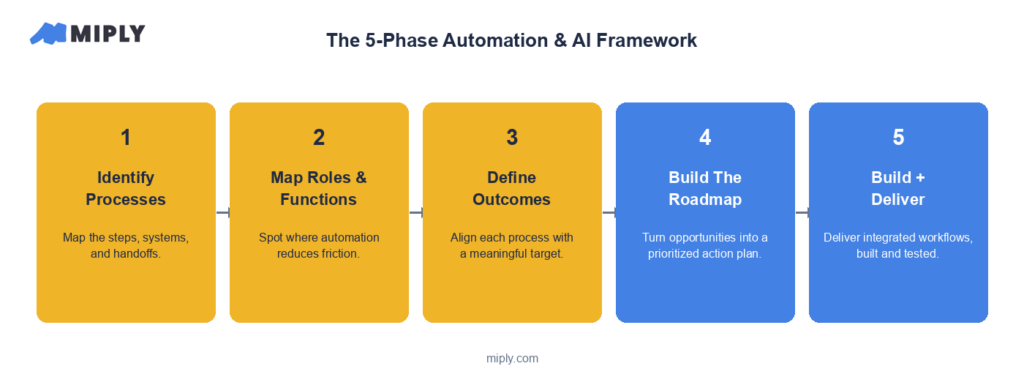
Most MSPs that try to add AI and automation to their service line start in the wrong place. They pick a tool, plug it into one client, and see what happens. MIPLY uses a 5-phase framework instead: Identify Processes, Map Roles & Functions, Define Outcomes, Build The Roadmap, and Build + Deliver. The first three phases are the ones most automation projects skip, and skipping them is the most common reason automation efforts stall.
We walk through the full framework in a new video, embedded below.
What Is the 5-Phase Automation & AI Framework?
It’s a structured path across a client’s core business processes, Sales, Marketing, Finance, and Operations, that takes an automation idea from a vague goal to a delivered, tested workflow. Each phase has a specific job. Skipping ahead to “build something” before the earlier phases are done is why a lot of automation work doesn’t hold up past the demo.
Phase 1: Identify Processes
This phase maps the steps, systems, and handoffs in a client’s workflow so that everyone, the client and the delivery team, is looking at the same picture. Before anything gets automated, it has to be documented the way it actually happens, not the way it’s assumed to happen.
Phase 2: Map Roles & Functions
Once the process is mapped, the next step is spotting where automation can actually reduce friction. This means identifying which roles and functions are creating bottlenecks, not guessing at where “AI” sounds like it belongs.
Phase 3: Define Outcomes
Automation without a target is just activity. This phase aligns each process with a meaningful, measurable outcome before any build work starts, so success can actually be evaluated later instead of assumed.
Phase 4: Build The Roadmap
This is where the opportunities identified in the first three phases get turned into a prioritized action plan. Not everything gets automated at once. This phase decides what gets built first and why.
Phase 5: Build + Deliver
The final phase is where integrated workflows and automations are actually built, tested, and delivered, not just switched on and left alone. This is also where a lot of DIY automation attempts fall short: the tool works in isolation but was never tested as part of the full workflow.
Why Do Most Automation Projects Skip Straight to Phase 4 or 5?
Because Phase 4 and 5 are the visible, exciting parts, the tool, the workflow, the demo. Phases 1 through 3 are slower and less flashy: mapping a process, identifying where the friction actually lives, agreeing on what “better” means. Skipping them doesn’t save time. It just moves the cost to later, when the automation doesn’t match how the business actually works and has to be redone.
Watch the Full Breakdown
Watch a walkthrough with our CEO< Cory Ruthhardt, in this video:
Frequently Asked Questions
How should an MSP add AI and automation to their business? Not by reselling AI licenses or bundling a tool with a security wrapper and calling it an “AI package.” The MSPs that make this work follow a structured process first: map the client’s actual workflow, find where the real friction is, define a measurable business outcome, then build and deliver automation against that outcome. Skipping straight to a tool is why most attempts don’t hold up.
Can an MSP offer AI services to their clients? Yes, and clients are already asking for it. The risk isn’t whether to offer it, it’s offering it as a generic “AI strategy” that’s hard for a client to evaluate or price. The MSPs winning this are packaging AI and automation as a specific, outcome-based service tied to something the client already cares about: reducing headcount cost, growing revenue, or passing an audit.
What’s the difference between an MSP and a Managed Intelligence Provider (MIP)? An MSP manages a client’s infrastructure. An MIP still manages that infrastructure but leads with business outcomes instead, using AI and automation as the delivery mechanism rather than the pitch. It’s a business-model shift, not a new technology category.
Where should an MSP start with automation, one client or a whole framework? Start with a structured process on one client’s business, not a company-wide “AI initiative.” Map the process, identify friction, define the outcome, then build a phased roadmap before delivering anything. The MIPLY 5-Phase Framework in the video above walks through exactly that path: Identify Processes, Map Roles & Functions, Define Outcomes, Build The Roadmap, Build + Deliver.
Does this apply outside of IT, like Sales or Finance? Yes. The framework is built to run across a client’s core business processes, including Sales, Marketing, Finance, and Operations, not just IT workflows.
Want to talk through where your business or your clients’ processes stand in this framework? Get in touch with MIPLY.
Recent Comments